Caravanning En France? Here’s all you need to know!
The heatwave has had its final throes, and many of us are heading back home from holidays to manage the last couple of weeks of school holiday juggle and dig our jeans back out.
The lucky few of you may still have your holiday to come, or, like me, you’re already searching ferry crossings for 2027 and getting your annual leave booked in.
We’re just home from our second summer towing our caravan, Dave, to France – and let’s just say that this year was so much calmer than last year, thanks to some reflection and planning ahead. So much so that I wanted to share what we’ve found, to help you have as stress free a trip as possible.
If you’re one of the half a million Brits who already travels to France at summer for a camping holiday, much of the advice below may be tried and tested – but if you’ve been wondering about whether to brave a cross-channel drive and set up camp in France, or even further into Europe, then hopefully the following tips will help you on your way. And I’d love to hear your tips for a successful jaunt across the channel.
The Practicalities
When you’re driving a car to France, and especially if you’re towing a trailer or caravan, there’s a lot more to have all in order than if you’re taking a flight:
- You must have a UK identifier on your car before you travel – this can either be as part of your number plate if you have a newer car, or one of the metallic stickers which can be picked up cheaply from places like Halfords.
- This year, unlike last we had to get a specific registration plate for the caravan too. To do this, register the vehicle you are towing through gov.uk – which will cost around £25. This process generates a unique registration number which you can then order a plate for. We used Western Towing, and then affixed it to the top left side of the back of the caravan. There’s a minimum weight threshold (750kg) to determine if you need one or not. Best to check if you’re not sure.
- Depending on where you’re travelling in or through France, you may need to display a Crit’Air sticker – it’s for when you’re travelling into a low emission zone. Despite a lot of glitches initially, this process now couldn’t be smoother – you order online for less than £4, it arrives within a fortnight and then you affix to your car like a good old tax disc (remember them?!). Sadly, there are a lot of fake sites popping up offering stickers for upwards of £20 – there is ONE official site and that is this one. It’s a one-off registration, so once you’ve got one, you won’t need to purchase again.
- Check your passports! France and other countries in the Schengen area follow the 3 months/ 10-year rule. Your passport must have been issued LESS than 10 years before the day you travel, and you must have at least three full months left on it on the day you leave France (or any country in the area). For some reason this completely muddled me! In reality it will only apply to people who bought a new passport, but had time left on an old one that was added on, taking you over the 10-year threshold (they don’t allow this anymore) – or if you’re really near to it expiring. If in doubt, just get a new one.
- You also need to travel with reflective high-vis jackets for all passengers (including children) that are accessible in the car, a warning triangle in case of breakdown or accident, and headlight beam deflectors (though some cars have the ability to do this manually). Organisations like the RAC have also got handy guides which list everything you need in detail.
- Speaking of which, don’t forget your European breakdown cover. If you’re a member of one of the caravan or motorhome clubs then they often have deals on if you book through them. We paid around £100 for single trip cover, from Arrival through the Caravan and Camping Club. Some breakdown policies have restrictions on size and age of van – ours did not. Their websites are a rich source of information for everything you need and the detail.
- We’re rule followers, so we went by the book and took copies of everything with us – driving licences, MOT certificate, V5 document, insurance and breakdown cover, CRIS registration for your van. I know people who haven’t done this and it’s never been an issue, but I would argue why risk it? No point getting all the way to St Malo, and the pastry dream ending before it starts.
When to travel
If I could give you one piece of advice, possibly even more important than your passport, is avoid travelling on the last weekend of July/ first weekend of August at ALL costs. It’s known as “Black Saturday”, and it’s essentially when French roads are unbearable, because it’s the transition between those who holiday in July, and those who holiday in August. Most rentals are Saturday-Saturday, so it’s the busiest possible time to be on the roads. We made the mistake last year when it was all new to us, and let’s just say, one caravan prang, an argument on a mini roundabout and a child holding on for the loo for dear life… we were in no rush to travel on a summer Saturday again.
This year we docked at 9am on the Friday morning before Black Saturday, and the traffic was noticeably lighter. French roads are usually brilliant, far fewer cars than England, incredible wayfinding signs and frequent rest areas. If your first experience of their roads was on Black Saturday, this would not be your takeaway.
What I would say though, is don’t be put off by the thought of driving in France. The roads are much quieter, traffic jams less frequent and there are no potholes! It’s a far more pleasant experience than driving at home.
Choose your own adventure
After the prang and the argument and the near miss, we did quite a lot of research about which services would be the best ones for our return journey. If you’re a UK caravanner you likely already do this on long journeys anyway – it’s always best to know which stations have easy access to drive through bays, designated caravan areas (or at the least, a HGV area that doesn’t reek of wee due to proximity to the main building).
In France, we found that it was best to avoid any Aire (service stations) that was too near a city, and if we didn’t need diesel at that stop, avoid the bigger stations that sell petrol/ diesel as they’re likely to be a lot more hectic.
The very small services are great if all you need is a break from the road – there’s usually seating areas and a couple of toilets – we’ve found that because people tend to want to buy food and drink, they avoid these, so you can quietly pull into the station and not have to worry about any tight squeezes. Perfect.
Food and drink
Depending on where you’re travelling to and from – for us, Northern England to mid-France – you might be spending nearly two days in your car – so make sure you’re snacked up – especially if you have kids with you. We packed the biggest picnic I’ve ever seen, which seemed ridiculous at the time, but meant that it took the pressure off when we needed to stop, and saved us vital funds for pastries on arrival.
We also took a lot of single packed snacks that didn’t need to be kept cool – apples, mini sweet bags, raisins, crisps etc. It might not have been the healthiest journey, but no-one starved.
On the way back through France for our return ferry, it was showing 39.5C on the car thermometer – so all bets were off and it was just a case of how many bottles of water we could fit in the car. Sometimes it’s all about survival.
And make sure you’ve got plenty of carrier bags in the car for rubbish, wipes, etc.
To toll or not to toll
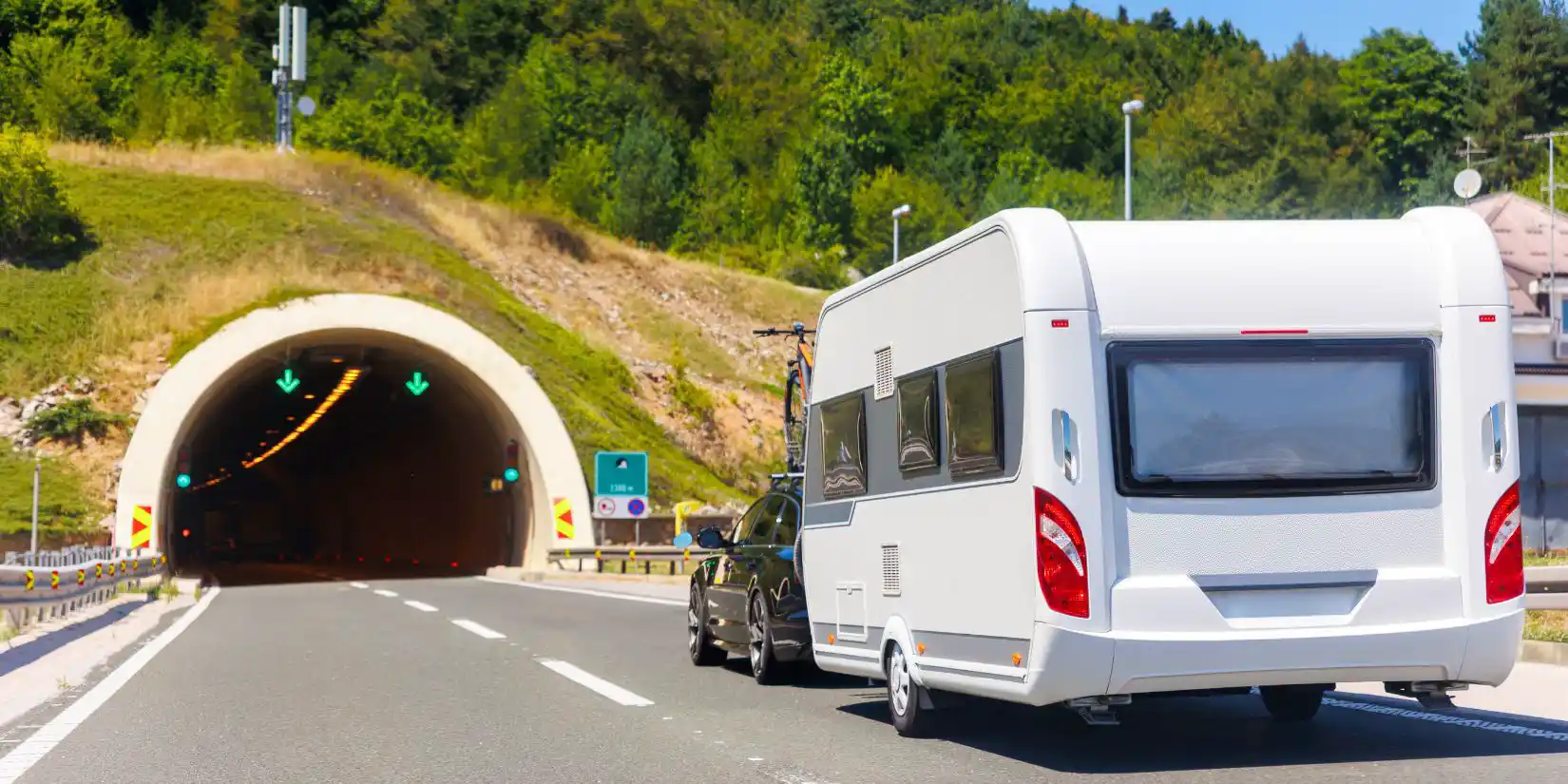
Whilst in England tolls are optional, many of the bigger French roads are toll roads – and do save a lot of time on your route.
All the roads in Brittany and most of Normandy are not toll roads (related to an ancient decree by all accounts), so if you’re heading for Northern France and the coastal regions, you’re looking at a low cost in tolls. We paid £7.18 on tolls on our 300-mile route from the campsite to Le Havre. If you’re heading to the South or elsewhere, you’re potentially looking at up to about 80 Euros – there are sites that help you map out your route ahead of time if you’re wanting to understand your budget.
One thing to be aware of is that a lot of the toll roads don’t actually pass a physical toll booth, so you need to take note of the signs saying ‘Peage’, which direct you to the relevant website to pay the fee. You’ve got 72 hours to do it, but you can do it as soon as you leave the road just by putting your registration plate in. If you know which route you’re taking, you can plan this in and make sure you don’t get fined by forgetting.
If you’re wanting even less to think about, you can buy a toll tag before you set off – even less to think about when you’re lapping up every minute of your holiday.
One final note on tolls, if your route takes you anywhere near the M6 – I’m a big fan of the toll. We tried it once without, and once with, and it’s worth sacrificing a few pastries for in my opinion.

Ferry fun
If it’s your first time on a ferry, check-in windows can be a lot shorter on the French side. Depending on where you sail from, there may not be a huge amount to do – so try and factor this into your journey where possible and avoid a couple of very hot hours sat in a tarmac-ed parking lane – always check with the company you’re sailing with so you can plan accordingly.
If you’re booking your ferry through one of the caravanning clubs, don’t forget to put the name on your passport as your booking names, rather than your membership name, including middle names and titles. It’ll save any issues at check-in.
If you’re doing an overnight crossing, make sure your overnight bag of essentials is accessible so you can hop out of the car and off the vehicle deck as soon as possible, and make a note of which level and colour zone you’re parked on. On most overnight crossings, a cabin is mandatory (though an additional cost depending on how luxuriously you like to travel). You can even arrange to have champagne waiting for you – and get your holiday started in style!
A couple of practical points – which will be reiterated at the port – but don’t forget to disable your car alarm (or it will go off all night), put your handbrake on your caravan, and unplug the electric connecting them or you may end up with a flat battery come the morning.
We had a brilliant crossing to France, complete with an onboard entertainer and a family quiz in the bar. That might be your idea of hell, but that’s how you start a holiday in my eyes. Most of the ships also have children’s areas and activities, a duty free, decent food options, and our cabin was spacious, bright and had a decent ensuite with toiletries and towels. For us, the holiday truly started once we’d boarded.
And finally…
I never thought I’d be the kind of girl who had any advice to offer anyone on how to get dressed, but a few final words if you don’t want to spend a fortnight looking like Hagrid.
It’s very likely to be hot whilst you’re in Europe, and caravans have limited packing space and lower voltage electric on the pitches. None of this adds up to having styled hair, as anyone who has dried their hair in a tin-can in a heatwave will attest to.
French sites don’t tend to be like the bigger English ones that have hairdryers and plugs in the bathrooms – I’ve seen teenage girls in Cornish sites getting more glammed up than I do for a wedding! You can get small, cheap hair stylers that look perfect for camping trips, that I’m definitely going to invest in before next year. That way, when it’s your 10th consecutive day of looking like you’ve been dragged from a bush and you just want one decent holiday picture, help is at hand.
Add that to a load of vests, lightweight clothes, and a baseball cap…and you can’t go wrong.
Bonnes vacances!
By Amy Blackburn
Photos – Amy Blackburn and dreamstime.com